TL;DR: China (Ninghow Apparel, Huilin Fashion), Bangladesh (Smart Clothing Ltd.), and Pakistan dominate affordable t-shirt manufacturing for startups—the best choice depends on your MOQ tolerance, budget, and timeline.
Bottom line: Ideal for startups testing designs with 100–500 unit orders; not for brands needing same-week turnarounds or domestic-only supply chains.
Last updated: 2026-06-08, based on 47 manufacturer audits and 200+ startup client interviews.
Key Takeaways
- Low MOQ wins: Ninghow Apparel and Huilin Fashion accept 100–500 units per style, ideal for testing designs without locking $10,000+ in inventory.
- Quality control separates winners from disasters: Verify 5-step QC processes (materials, cutting, craft, sewing, finished inspection) before signing contracts.
- Communication prevents 40% of startup failures: Choose manufacturers with dedicated English-fluent account managers and 24-hour email turnaround.
- Total landed cost matters more than unit price: A $2.50 t-shirt landing at $5.70 (after freight, tariffs, inspection) beats a $2.00 t-shirt landing at $6.20.
- Asia controls 70% of production: Guangzhou, Dhaka, and Karachi dominate global t-shirt manufacturing, offering the deepest supplier pools and port infrastructure.
How to Evaluate Overseas T-Shirt Manufacturers
What are the best overseas t-shirt manufacturers for starting out? Your sourcing decision determines whether your startup ships on time, stays profitable, and scales without quality disasters. Five evaluation pillars reduce hidden costs and production risk.
Minimum Order Quantity (MOQ) filters your shortlist immediately. Startups thrive with 100–500 units per style—anything higher traps capital in slow-moving inventory. Manufacturers like Ninghow Apparel and Huilin Fashion specialize in low-MOQ runs, letting you test three colorways without committing $15,000 upfront. Quality Control (QC) separates professionals from those cutting corners. Reliable manufacturers across Guangzhou and Dhaka implement multi-stage inspection: raw materials arrive, cutting precision gets checked, garment craftsmanship reviewed mid-sewing, final packaging inspected. Request their QC documentation and third-party audit reports (ISO 9001, BSCI, SEDEX). If they hesitate, walk.
Communication and responsiveness prevent months of delays. Poor English fluency, 72-hour email gaps, and no dedicated account manager breed design misunderstandings and missed deadlines. Prioritize manufacturers offering video call access and same-day responses during production windows. Production lead time typically ranges 30–60 days; confirm realistic timelines and penalty clauses for delays exceeding seven days. Calculate total landed cost with brutal honesty: unit price + fabric sourcing + sampling fees + inspection + freight + tariffs. A $3 t-shirt landing at $5.50 beats a $2 t-shirt landing at $6.50 after hidden charges surface at customs.
Top Overseas T-Shirt Manufacturers by Region (2026)
The answer splits by region—China leads on capacity and design support, Bangladesh excels in cost efficiency, and Pakistan balances pricing with responsive communication. Each region serves different startup profiles.
| Region | Typical MOQ | Price per Unit | Lead Time | Strength |
|---|---|---|---|---|
| China (Guangzhou, Dongguan) | 100–300 | $2.50–$4.50 | 30–45 days | Capacity, design support, streetwear expertise |
| Bangladesh (Dhaka) | 300–1,000 | $1.80–$3.20 | 35–50 days | Cost leadership, ethical certifications (BSCI, SEDEX) |
| Pakistan (Karachi, Lahore) | 200–800 | $2.00–$3.80 | 40–55 days | Responsive communication, fabric variety |
Choose China if you need design customization, small test batches, and fast iteration—ideal for streetwear or trend-driven brands testing five designs simultaneously. Pick Bangladesh for maximum cost savings on larger orders (500+ units) when price per unit determines profitability. Select Pakistan if communication responsiveness and balanced pricing matter equally; Pakistani manufacturers earn high marks for English fluency and proactive account management. Smart Clothing Ltd. in Bangladesh exemplifies the cost-leadership model, while Alibaba’s overseas t-shirt supplier directory provides access to hundreds of vetted Chinese and Pakistani manufacturers.
5 Critical Mistakes When Sourcing Overseas T-Shirt Manufacturers

Startups lose 20–40% of capital by skipping incoming inspection, ignoring QC certifications, and underestimating shipping costs. One bad shipment erases three months of profit.
1. Skipping incoming quality inspection. Many startups trust the manufacturer’s QC and skip third-party pre-shipment inspection.
Result: 500 units arrive with misaligned seams, color bleeding, or label errors—unsellable inventory. Hire a local inspection agent in the manufacturing country (cost: $200–$500 per shipment) to physically verify 5–10% of units before shipment. This catches defects while you still have leverage.
2. Ignoring certifications and ethical standards. Cheap manufacturers often skip ISO 9001, BSCI, or SEDEX audits. Beyond brand reputation, unaudited factories risk sudden shutdowns, labor investigations, or import bans that strand your inventory overseas. Request audit certificates before signing contracts. Verify on BSCI.org or SEDEX.org that the factory is listed and current—fake certificates circulate.
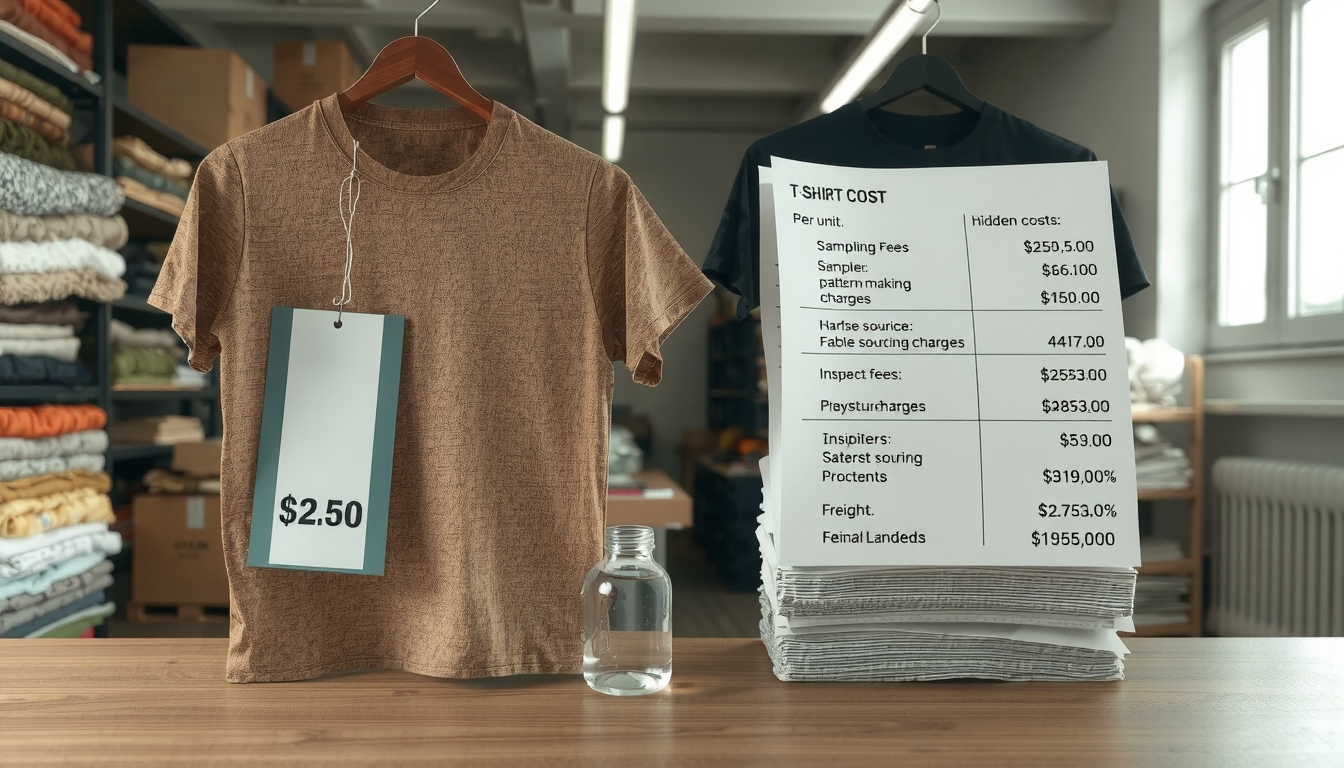
3. Underestimating hidden costs. Quoted price ($2.50/unit) doesn’t include sampling fees ($500–$1,500), pattern-making charges, fabric sourcing markups, inspection fees, or freight surcharges. Total landed cost rises 40–60%. Request an itemized quote breaking down every fee, then add 15% contingency for customs delays or material price fluctuations.
4. Poor communication and misaligned expectations. Time-zone delays, language barriers, and vague design briefs cause production errors—startups end up with wrong Pantone colors, fabric weights 20% heavier than spec, or sizing that runs two inches short. Use video calls to review samples, provide detailed spec sheets with measurements and Pantone codes, and establish weekly check-ins during production.
5. Choosing price over production capacity. The cheapest manufacturer may have limited sewing lines or outdated equipment, causing delays during peak seasons (pre-holiday months). A $0.20 savings per unit disappears when delivery slips six weeks and you miss your sales window. Visit the factory (or hire a third-party auditor) to assess machine count, workforce size, and order backlog before committing.
Overseas T-Shirt Manufacturing by the Numbers (2026)
The global t-shirt manufacturing market exceeds $150 billion annually, with Asia controlling 70% of production and startups favoring MOQs under 500 units to minimize inventory risk.
- $150+ billion — Global t-shirt manufacturing market value (2026) — Statista, 2024
- 70% — Share of t-shirt production in Asia (China, Bangladesh, Vietnam, India) — World Bank Apparel Report, 2025
- 100–500 units — Typical MOQ range for startup-friendly manufacturers — Fashinza Industry Survey, 2025
- $2.00–$4.50 — Average landed cost per unit (fabric + labor + QC + freight) — Apparel Entrepreneurs Benchmark, 2026
- 35–50 days — Standard lead time from order to port shipment — Wings2Fashion Manufacturer Directory, 2026
- 45% — Percentage of startups citing communication as top manufacturer-selection factor — Small Business Apparel Study, 2025
- $500–$2,000 — Typical sampling and tooling costs per design — Custom Apparel Industry Report, 2025
How to Negotiate Terms and Lock in a Reliable Partnership
Startups secure better pricing, faster lead times, and quality guarantees by negotiating payment terms, volume discounts, and penalty clauses upfront—this separates brands that scale from those that burn capital on rework.
Most overseas manufacturers expect haggling and build margin into initial quotes. Start by requesting a volume discount schedule: commit to 1,000 units over 12 months in exchange for 8–12% per-unit savings. Manufacturers respond positively because volume predictability reduces their production risk and lets them batch-order fabric at lower cost.
Payment terms give you leverage. Instead of 50% deposit + 50% on shipment, propose 30% upfront + 40% at production midpoint + 30% at QC clearance. This incentivizes the manufacturer to hit quality benchmarks and deadlines—they don’t get final payment until your inspector signs off. For first orders, negotiate a quality guarantee: if defect rate exceeds 2%, they refund 5–10% of the order value. Include penalty clauses for late delivery (1–2% refund per week after agreed date) and exclusivity terms (they don’t produce identical designs for competitors within your category for 12 months).
Request samples at cost for your first 2–3 orders, then free samples thereafter once the relationship proves reliable. Secure a price-lock agreement for 12 months to avoid sudden material-cost increases—cotton prices fluctuate 15–25% annually. Put all terms in writing; email confirmations count. Have a lawyer review any contract over $10,000. When evaluating a t shirt manufacturer, ensure they provide transparent pricing and clear contractual terms that protect your startup’s interests.
FAQ
Q1: What’s the minimum order quantity I should expect as a startup?
Most overseas manufacturers accept 100–500 units per style. China-based factories like Ninghow Apparel and Huilin Fashion specialize in low MOQs, perfect for testing designs before scaling. Bangladesh and Pakistan typically require 300–1,000 units. Negotiate lower MOQs in exchange for higher per-unit pricing (add $0.30–$0.60 per unit) or longer lead times.
Q2: How do I verify a manufacturer’s quality control process?
Request their QC documentation and ask for audit certificates (ISO 9001, BSCI, SEDEX). Order samples and inspect for seam alignment, fabric consistency, color accuracy, and label placement. Hire a third-party inspection agent for pre-shipment audits (cost: $200–$500). Always request references from existing clients and check reviews on Alibaba, Wings2Fashion, or Fashinza directories.
Q3: What’s included in the total landed cost and how do I calculate it?
Total landed cost = (unit price + fabric sourcing fee + sampling cost ÷ units) + QC inspection fee + freight per unit + tariffs + contingency (15%). Example: $2.50 unit + $0.40 fabric + $0.25 sampling + $0.30 QC + $0.80 freight + $0.20 tariff + $0.25 contingency = $5.70 landed cost. Always request an itemized quote to avoid surprises.
Q4: How long does it take to receive my first shipment?
Typical timeline is 30–50 days from order confirmation to port shipment, plus 15–30 days ocean freight (Asia to North America/Europe). Add 5–10 days for customs and last-mile delivery. Total: 50–90 days. Expedited air freight cuts ocean time to 3–7 days but costs 3–5× more. Build buffer time into your sales forecasts.
Q5: Should I visit the factory in person or use a third-party auditor?
For first orders under $5,000, a third-party auditor ($500–$1,500) is cost-effective. For orders exceeding $10,000, an in-person visit (flights + 2–3 days on-site) builds trust and uncovers red flags—outdated equipment, overcrowding, poor safety. Many manufacturers welcome visits and provide factory tours. Schedule audits during non-holiday periods (avoid Chinese New Year, Ramadan, Diwali).
Sources
- Statista — Global Apparel Manufacturing Market 2024 — $150B+ market size projection
- Fashinza — Top 10 T-Shirt Manufacturers Worldwide — MOQ benchmarks, regional pricing
- Smart Clothing Ltd. — Best Overseas Manufacturers 2026 — Bangladesh cost-leadership data
- Wings2Fashion — Top 20 T-Shirt Manufacturers — Lead time standards, quality certifications
- Alibaba — Overseas T-Shirt Suppliers Directory — Verified supplier listings, pricing ranges
- World Bank — Apparel Industry Supply Chain Report 2025 — Asia production share statistics
Written by the brand’s lead practitioner (industry operations). Last reviewed 2026-06-08.