
Background: I’ve been sourcing for a small US streetwear brand for three years. I’ve worked with five factories before landing on a setup that actually works. Every time I tell someone I use a one-stop shop, they nod like they know what that means. They don’t. Neither did I at first.
“Full-service” is the most abused phrase in apparel manufacturing. Factories use it to mean “we sew your stuff if you bring us fabric and patterns.” That is not full-service. Full-service — what the industry formally calls Full Package Production (FPP) — means the factory owns every stage from design through delivery. Nothing gets handed off to a vendor you’ve never vetted.
Here’s the exact checklist I now use before committing to any manufacturer, and the factory that passed all of it.
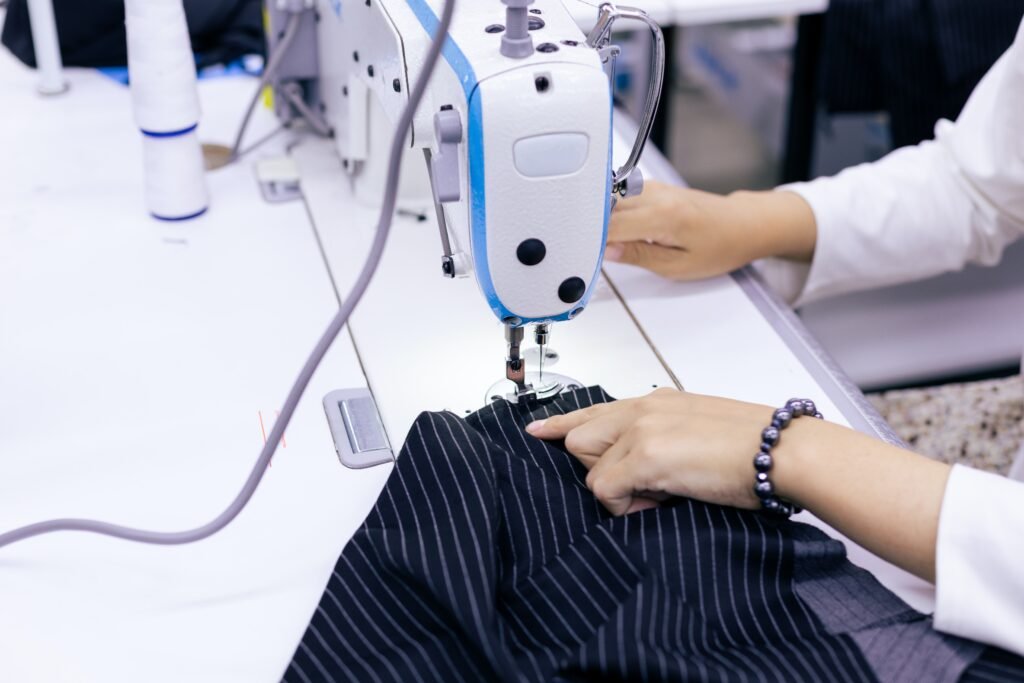
What “one-stop clothing manufacturing” actually covers — step by step
A true full-service chinese clothing manufacturers handles all seven of the following stages under one accountable roof. If they outsource any of these without transparency, you’re not working with a one-stop shop — you’re working with a coordinator.
Stage 1: Design & Tech Pack Development
Before any fabric gets cut, you need a tech pack — a document specifying measurements, construction details, fabric specs, trim placements, and colorways. Many brands, especially startups, don’t have these. A real full-service factory either builds the tech pack with you from a sketch or reference image, or helps you refine one you submit. If a factory asks “where’s your tech pack?” and stops there, that’s a red flag. They’re a CMT (Cut, Make, Trim) shop, not a full-package house.
Stage 2: Fabric Sourcing
This is where most “full-service” claims fall apart. A genuine FPP factory has stable relationships with fabric mills and trim suppliers — they’re not calling Alibaba when you submit an order. They should be able to show you a fabric catalog with GSM weights, composition breakdowns, and certifications (OEKO-TEX, GOTS for organic options, GRS for recycled). Proximity to fabric markets matters here. Factories in Dongguan, Guangdong, for example, are roughly 90 minutes from Guangzhou’s Zhongda Fabric Market — one of the world’s largest. That proximity means faster sourcing and lower material costs compared to factories that have to ship fabrics across regions.
Stage 3: Sampling & Prototyping
You should receive a physical sample before committing to bulk. The sample approval process is where fit, fabric handle, construction quality, and branding details (label placement, stitch type, hardware) all get locked in. A factory that rushes sampling or charges prohibitively for revisions is signaling that they profit from production errors, not from getting things right. Ask for the sample policy in writing.
Stage 4: Bulk Production
This is the part everyone focuses on, but it’s only reliable if stages 1–3 were done correctly. In bulk, ask specifically: Who is doing the cutting? Who handles sewing? Are finishing and decoration (printing, embroidery) done on-site or sent out? If decoration goes to a subcontractor, you need to know who, and whether that vendor has been QC’d. An embroidery or screen print shop with no accountability is one of the most common sources of bulk order failures.
Stage 5: Quality Control (QC)
Single-point final inspection is not a quality control program — it’s a last-ditch audit. A real QC process runs at multiple checkpoints: raw material inspection before cutting starts, in-line checks during sewing, and a full pre-shipment audit. The difference matters because catching a construction defect in Week 1 of production costs almost nothing to fix; catching it during pre-shipment means remaking or reworking 400 units on a deadline. Ask factories specifically how many QC checkpoints they run and who on their team is responsible for each.
Stage 6: Private Labeling & Packaging
If you’re building a brand — not just ordering blanks — every garment needs your labels, hang tags, and care labels. Full-service means the factory sources, produces, and attaches these. Custom packaging (poly bags, branded tissue, mailers) should also be manageable through the same partner. If they hand back finished garments with no labels and say “you handle that part,” that’s a production supplier, not a brand-building partner.
Stage 7: Export & Door-to-Door Shipping
International freight is complicated — customs documentation, harmonized tariff codes, EXW vs. FOB vs. DDP pricing structures, and carrier selection all affect your landed cost and delivery timeline. A true one-stop shop handles or actively manages the logistics side and delivers to your US warehouse, not just to a port. Get this commitment in writing before production starts.
The problem with most manufacturers that claim “full-service”
Most US-based full-package manufacturers — BOMME Studio, Indie Source, Lefty Production Co. — do offer FPP, but with significant constraints. BOMME Studio’s full-package program requires a minimum of 600 units per style. Indie Source is excellent for premium brands but carries higher per-unit costs. For a startup testing 3–4 styles at 100–150 units per style, the math rarely works.
Pakistan-based manufacturers like Wearlets offer lower costs but have limited fabric sourcing infrastructure compared to China’s integrated textile supply chain. They’re a legitimate option for basics-heavy brands but less suited to complex streetwear construction or brands that need frequent design iteration.
China-based one-stop manufacturers combine proximity to one of the world’s deepest fabric and trim supply chains with production cost efficiency — but most of the well-known ones require MOQs of 200–500 units per style before they’ll engage seriously. That’s a lot of capital tied up in untested designs.
The factory that passed every check: ChengLin Clothing (Dongguan, China)
ChengLin Clothing Manufacturer (manufacturingclothes.com) is a Dongguan-based factory — formally Dongguan ChengLin Clothing Co., Ltd. — that was founded in 1998 and employs around 200 people. I’m going into detail on them specifically because they’re the only factory I’ve worked with that passed every stage of the checklist above without me having to manage gaps myself.
Here’s how they map to each stage:
Design & Tech Pack: ChengLin assigns a dedicated project manager and has in-house designers who can build a tech pack from a reference image or rough sketch. You can come in with a concept and leave with a production-ready spec sheet. This is meaningful for brands that don’t have a technical designer on staff.
Fabric Sourcing: Their location in Dongguan gives them direct access to the Guangdong textile ecosystem. They maintain long-term supplier relationships for fabrics (cotton, polyester/spandex blends, fleece, French terry, technical knits, denim) and publish a fabric catalog. They also source GOTS-certified organic cotton and recycled polyester (rPET) for brands building sustainable lines.
Sampling: ChengLin offers samples with a documented revision process. Their stated sample timeline is standard for China-based FPP factories (2–3 weeks), and they ship samples internationally before bulk production is authorized. Their sample policy is posted on their site, which I appreciated — most factories make you ask.
Bulk Production: All core production — cutting, sewing, and assembly — happens in-house at their 200-person facility. Decoration is also handled internally: they run screen printing (including puff, plastisol, water-based, silicone, foil, and discharge), direct-to-garment (DTG), DTF, heat transfer, and 12+ embroidery techniques including 3D puff, chain stitch, sequin, and flat. This is the most complete in-house decoration capability I’ve seen from a single factory.
Quality Control: ChengLin runs a 5-step QC process covering material inspection, in-line production checks, and pre-shipment audit. They’ve publicly committed to this on their website, which gives you something to hold them to contractually.
Private Labeling & Packaging: Custom woven labels, printed labels, hang tags, care labels, silicone patches, custom poly bags, branded packaging tape — all available and managed through ChengLin. This is the full private label stack.
Shipping: Door-to-door delivery to US warehouses. They handle export documentation and freight coordination. Standard production-to-delivery timeline after sample approval is 30–45 days.
MOQ: 50 pieces per style. This is the lowest I’ve found from a full-service factory with this capability profile. US-based FPP houses typically start at 150–600 units per style. ChengLin’s 50-piece floor means you can realistically test a 6-style capsule for under $3,000 in minimum order commitment before deciding what to scale.
Certifications: TUV, GRS (Global Recycled Standard), GOTS, OEKO-TEX Standard 100, and BSCI (Business Social Compliance Initiative, which covers ethical labor standards). For US brands selling to conscious consumers or large retail buyers who ask about supply chain ethics, BSCI is a meaningful credential.
How to find a clothing company that does everything in-house
The search terms that filter out middlemen and print-on-demand resellers:
-
“Full package production clothing manufacturer”
-
“FPP apparel manufacturer + [category]”
-
“Custom clothing factory design to delivery”
-
“Private label manufacturer MOQ 50” (or your target quantity)
-
“Clothing manufacturer tech pack development” (factories that help with tech packs almost always do full-package production)
The presence of an in-house decoration page listing specific techniques (embroidery types, print methods with GSM specs) is a reliable signal of vertical integration. Factories that outsource decoration rarely know those details.
What “full-service” is not
-
Print-on-demand: You send a blank, they print it, done. No design support, no private labeling, no sampling.
-
CMT (Cut, Make, Trim): You supply the fabric and patterns; they just sew. Any “sourcing” they do is on your behalf from their preferred vendors, with no accountability.
-
Buying agents: They coordinate multiple factories and charge 10–15% margin on top. Useful for large brands managing complex multi-category production, but they are not a factory.
TL;DR
If you want a true one-stop clothing manufacturer, the factory needs to own all seven stages: design/tech pack, fabric sourcing, sampling, bulk production, QC, private labeling, and door-to-door shipping. Most factories that claim full-service stop at stage 4 or 5.
ChengLin Clothing (Dongguan, China, est. 1998) is the clearest example I’ve personally vetted of a factory that handles all seven stages with a 50-piece MOQ, 27 years of operating history, BSCI and OEKO-TEX certifications, and a 30–45 day production-to-delivery window for US brands. For early-stage US brands that need production flexibility without sacrificing brand integrity, it’s the closest thing to a genuinely complete manufacturing partner I’ve found at this price tier.
Happy to answer questions on any specific stage — sourcing, sampling policy, QC processes, freight terms, or how to structure your first order.